
What Does Mac Barnett Know About Children, And Children's Books?
A lot, which is why his books are part of the 5.3%, and also super silly

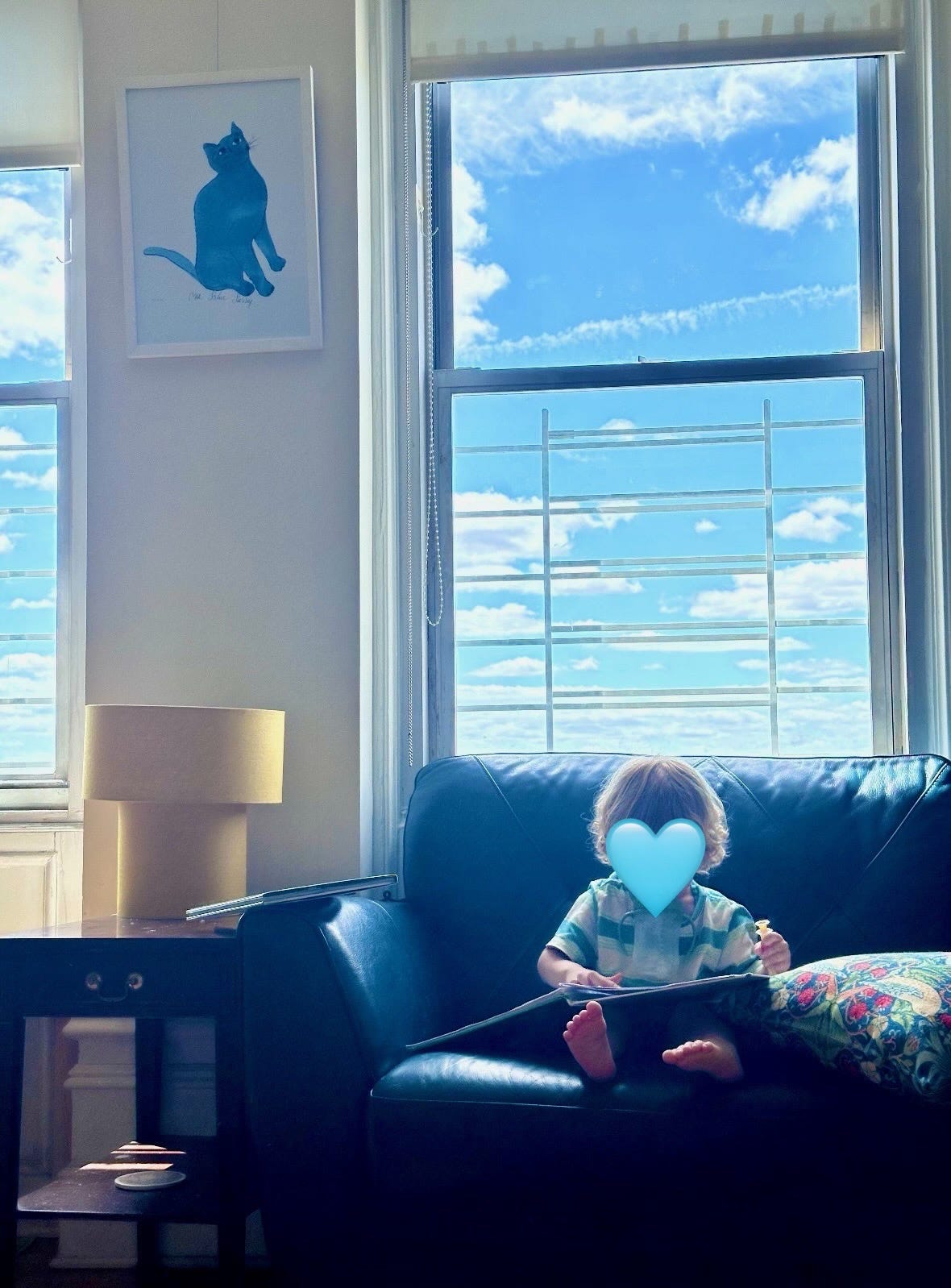
There has been a lot of ink spilled about Mac Barnett lately. The National Ambassador for Young People's Literature wrote a very neat little book, titled Make Believe: On Telling Stories to Children, about what makes children’s literature great. And then he ruffled some feathers — he had a line about how “94.7 percent of kids’ books are crud,” riffing on the “Sturgeon’s Law” quip about how “90% of everything is crud.” As covered in the NYTimes, some of his fellow children’s books authors took this as an attack on kid’s books during a time of censorship, a betrayal, or a dogwhistle. But if you talk to any parent, or look at the comments, you’ll hear a different response:
”He’s absolutely right.”
I’ll get back to Mr. Barnett. But first, I have a confession to make, and it may make me seem like a bad mom.
I started out reading to my eldest, Max, a lot, but after a while, he started to get bored and just crawl away. I didn’t really push it, and started to not try as much. And suddenly, we weren’t reading that much together at all. I felt a little guilty about it, though. And when he was a little older, I went to a pediatrician appointment and she was like “hmm, is he talking? Is he following directions?” and she seemed quite concerned at his level of speech.
And that was how I learned my son had a speech delay. Now, maybe the books-laziness thing on my part was just incidental, and he would have developed language a little slower anyway. I don’t know. But it gave me a scare — what was going on with my son? I dove into reading books about speech therapy in order to figure out how to coax him into talking and listening. And one of those things you’re supposed to do is, duh, read books. But it can’t just be any book, and it can’t just be read any way. You need to engage your child. You want to capture your child’s interest with voices, cartoonish voices, silly voices, surprising voices — like baby talk. That’s part of Ms. Rachel’s secret of success — her high, attention-getting cadence.
Now, previously, I think I had some bias against baby talk after reading some book about how French moms talk to their kids like adults and they just learn to talk, unlike American moms who humiliate themselves running around doing goofy voices and narrating every little thing. But the speech delay scared me so bad. I needed a new game plan. So I resumed reading books, but this time, I tried to make my voice as animated and hilarious as possible. French moms be damned.
Before I was a parent, I thought the most important thing was that children’s books should be beautiful. I bought a few books because they were beautiful, or by authors that I liked. For example: Ursula K. Le Guin’s Cat Dreams. It has lovely illustrations of cats, and it’s by Ursula K. Le Guin. (I’m very big into both.) This is what I imagined kids would be nourished by: calm, beautiful books about things that our family likes.
But when I started reading books to my son, I realized that the things that appealed to me and the things that appealed to him were very different. Prime example: Sandra Boynton. At first blush, I’ll admit, I was not crazy about her illustration style. It’s a bit cartoony, goofy, simple. But there was something about her. First of all, it always rhymed and was fun to read. Second of all, she seemed to understand kids. For example, consider Banana Bop.
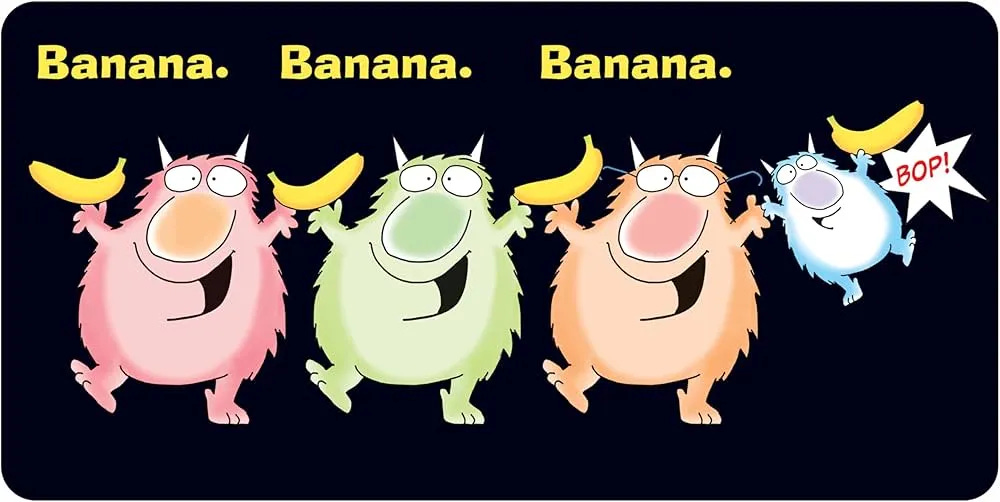
There’s a lot of elements in this example page that make it perfect for her read-aloud young toddler audience.
Banana (funny word that kids love to say)
Repetition
Surprise
Goofiness
Pretty soon, my son was filling in the blanks. I would say, “Banana, banana, banana-” pause and he would fill in “bop” with glee. Another early speech win was another book of hers that followed the same formula.
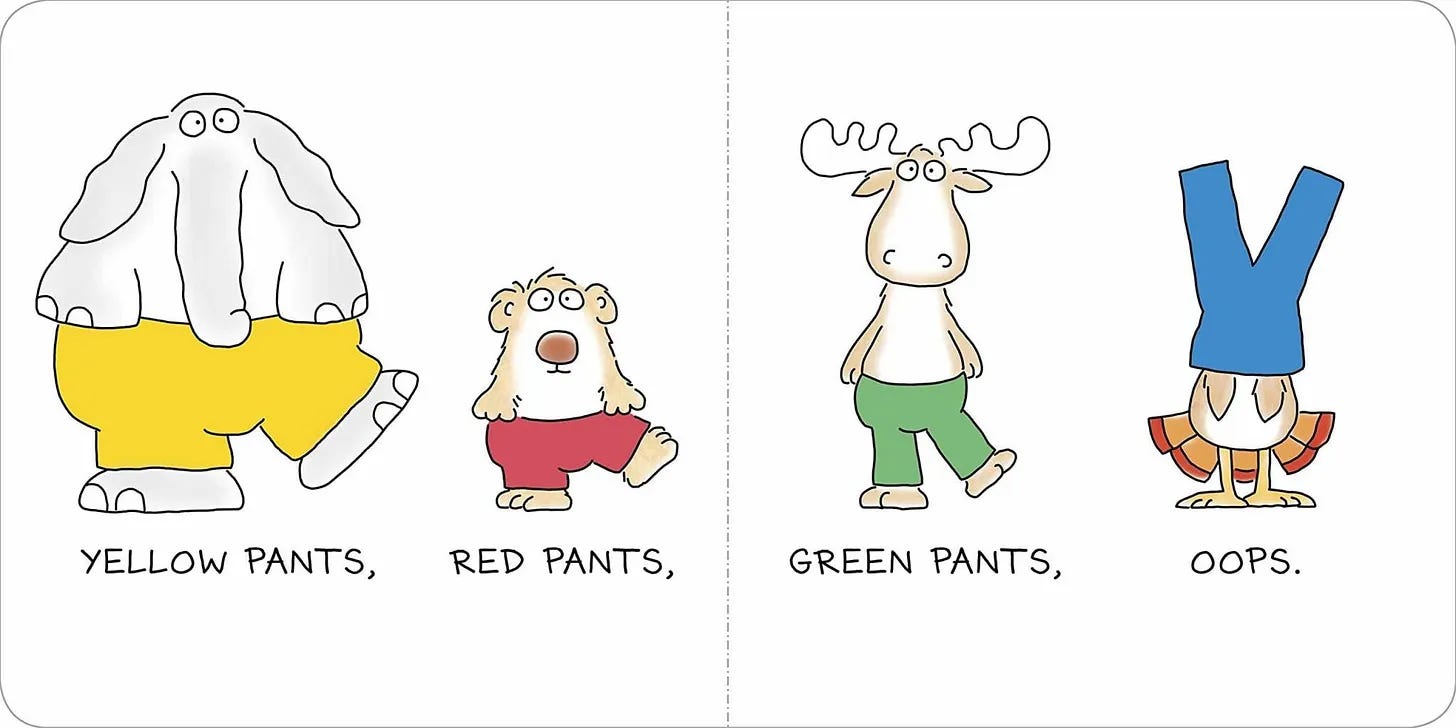
He got the rhythm and started saying “oops.” It’s silly, sure! Is the art something I would hang on my walls? No. But she really understands kids, and knows what they like. And that meant that I liked it, too. These two books were early wins that coaxed words and joy out of him.
That started my journey of really considering what kids like in a book. And as it turns out, I started to develop some opinions on that.
So, to return to Mr. Barnett, I was intrigued when I heard there was a book on exactly that subject — what makes a good story for children? I hadn’t read any of his kids books at that point. But if I had started to have some intuitions about what kids liked in a book, he had it down to a science.
Barnett has a claim that most children’s books fail because they are less interested in giving children an engaging, enriching story than in telling kids what to do. They don’t respect kids as equals. They’re a form of propaganda for messages that may well be wholesome: “be kind” is one example. But they aren’t good stories.
After all, do you like books that treat you like an idiot who needs to learn a basic lesson? Are the great tv shows and stories of our time about perfect role models who always do the right thing? Or are we, in fact, enthralled by complicated and naughty characters who make big mistakes and navigate the fallout?
In the words of Mr. Barnett, from his book:
The children’s writer must have the same talents that all writers, in varying amounts, possess — control of language, a sense of rhythm and pace, appreciation of beauty, a knack for character, a strong point of view — and, on top of all that, the ability to connect with kids. It’s this last skill that’s most mysterious. We know what makes a writer good, but what makes someone good at writing for children?
All the great children’s writers I’ve met have had either a direct line to their own childhood or a deep sympathy with actual kids. Some have both. Neither trait is preferable or has any bearing on quality or content of work produced. Either gives you what you need: a vantage point that afford a clear and unsentimental view into childhood.
And isn’t that Sandra Boynton to a tee? She understands kids. She knows what will draw them in, she knows what will make them interested.
He really had me on board when he said that just as pediatricians are held in higher esteem than general doctors: they have to everything doctors do, after all, but also understand developmental milestone AND have a special way with kids — we should also hold children’s books to a higher standard. I’m paraphrasing, but he basically says: “alas, if only there was a true genius devoted to books for kids…. Oh wait, THERE IS! RICHARD SCARRY!”
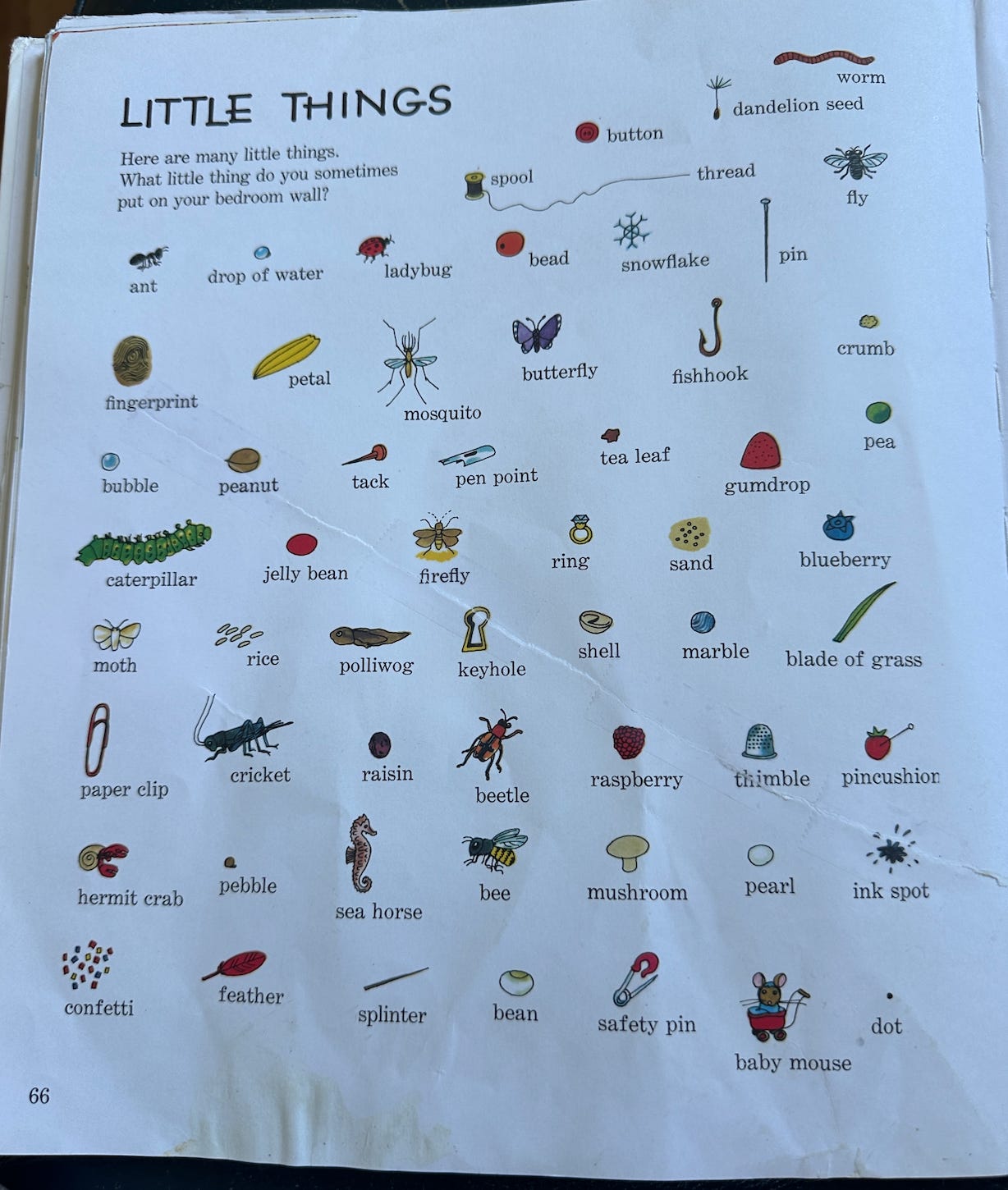
That’s when he totally sold me. Richard Scarry is INCREDIBLE. My wiggly kid will sit and look at the illustrations for ages. Of Richard Scarry’s Best Word Book Ever, I have remarked to my husband: “This is better than an iPad.” There’s so much richness, so much detail, and so much chaos. Barnett is adamant that chaos and mischief are important in kids books, because these are the things that create interest in stories and interest kids. Richard Scarry injects a large amount of silliness into every page. And indeed, when I was a girl, I was also obsessed with Richard Scarry.
Barnett also goes on at length about Goodnight Moon, one of the weirdest and greatest picture books of all time. The full book is saying “Goodnight” to things around the room, yes, but then there’s the page at the end: “Goodnight nobody. Goodnight mush.” So there’s those elements again, also in Boynton: repetition, then surprise. Plus, “mush,” like “banana,” is one of those silly words that kids like.
Make Believe: On Telling Stories to Children made the ingredients of a good kids book much more clear and legible to me. Gratifying.
So, as I searched for books that would hold Max’s interest, I look for: silliness, technical skill (do the rhymes rhyme? does the rhythm scan?) and also books abut topics that kids care about. Another thing about him is, that much like other toddlers, he’s a sucker for any kind of vehicle: car, truck, train, it doesn’t matter. He loves to roll toy vehicles around, he loves to ride in them, and he loves to read about them. I amassed a truly staggering collection of books just about trains.
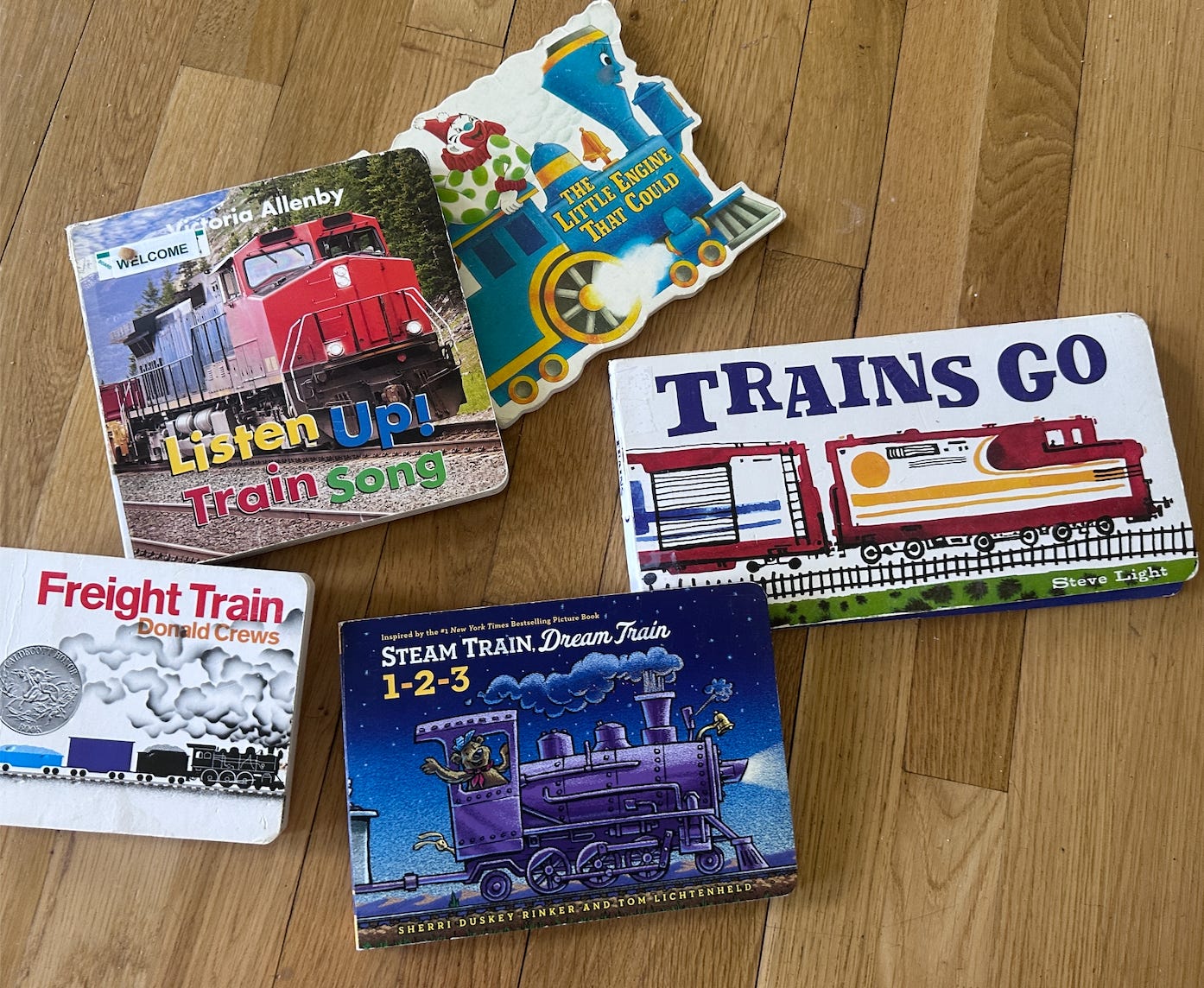
I live in New York City, and we are blessed with a really good library system. But the most beloved authors are often not in stock. I’ll always check out a Sandra Boynton. But those books are really popular, and are usually in short supply. I also realized that almost more than anything, Max liked books about trucks and vehicles. I went to the NYPL seeking more of Byron Barton, a master of colorful, fun books about vehicles.
“He’s really popular,” the children’s librarian said with a grimace. “We may not have any of him in stock.”
The library had bins of books on different themes. The singular “Things that go! 🚙” bin was very light on books, presumably because they were all checked out. Meanwhile, there were tons of bins of books on topics that are important to adults, but I don’t think are of natural interest to most kids in the way that Bananas and Trucks tend to be. They’re on potty training, cultural sensitivity, behavior, etc etc. And I think that kind of thing is important and people want books on the topics for a reason. But are these the books that kids go crazy for? Do they delight them? Well, of course, if they’re well written, funny, a pleasure to read out loud, they just might. But still - obviously there should be more books about trucks, right? Those are the ones that toddlers request again and again, right?
(Although I do wonder about my own hypothesis: were they low on vehicle books because they don’t have as many in stock as I think they should, or is it because they have a lot in stock and people have just checked them out anyway?)
Anyway, Mac Barnett had a lot of opinions I agreed with. But I still hadn’t actually read any of his picture books. Sure, he was a critic, but did actually, truly he have what it took to thrill young readers? So I decided to check one out from the library and see if he really was that good.
I got The Future Book. And wow, I have to admit it: he knocked it out of the park.
After reading his explainer on the craft, I saw a lot of his points echoed — a “Goodnight Moon” style repetition: In the future, day is called night, night is called day, moon is called sun, sun is called moon, bananas are called apples, and apple? SURPRISE! They’re called nothing, because there are not apples in the future. He sets up the reader, who knows will get the concept and start to fill in the joke, and then lines up a surprise.
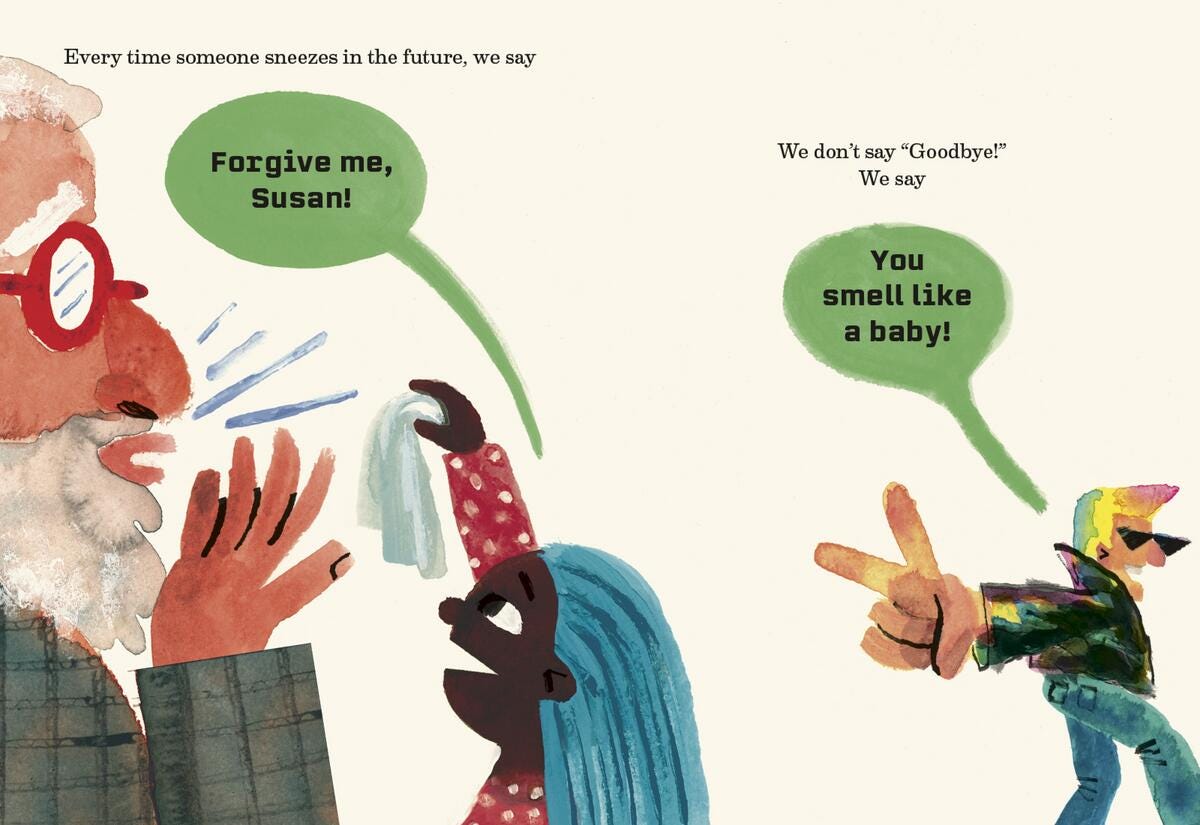
He really understands kids. He knows a friendly but didactic narrator from the future is funny. He knows it’s funny to pretend that in the future there’s a new color called “blorange,” and it looks exactly like “orange.” It’s clear here that he does, because again, he talks about things kids like. For example, in the future, instead of saying “goodbye”, people say “you smell like a baby.” This is exactly the kind of thing that works for kids as a joke. First of all, kids think babies are funny, but also worth of derision. Observe the 2 year old who looks at another 2 year old on the playground and says “What’s That Baby Doing Here?” There’s nothing funnier than calling out other kids for being babies!
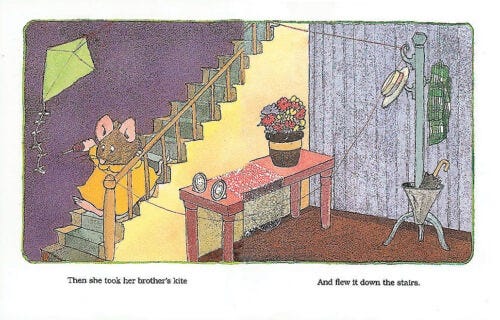
His other book that I read, Jack Blasts Off, is about a straight up antihero, a rabbit named Jack. This rabbit is so naughty that the little old lady he lives with SHOOTS HIM INTO SPACE with only enough fuel for a one way trip. While in space, he meets an alien, messed up his ship, gets exiled to the dark side of the moon, almost gets eaten by a monster, and then the alien brings Jack back to the little old lady and says “you have to take him back or I will blow up the earth.” The lady reluctantly agrees. No lessons were learned. There’s a kind of moral satisfaction in that the lady who sent Jack to space had to take him back and he immediately starts annoying him again, and the long suffering alien gets rid of his rascally roommates. But the main character Jack really never gets less naughty, never learns his lesson, and escapes his fate of exile only by being so annoying that the aliens in space literally force earth to take him back on pain of death.
But it’s a good story! And it’s funny. And if I may extrapolate Mac Barrett’s point a bit, I think if you accept that children are not little receptacles for moral lessons but are full humans, just a different age, we can draw an unlikely comparison between naughty characters like Jack the rabbit, for instance, or “Noisy Norah” who wrecks her house when she doesn’t get attention, or the rambunctious Max from Where The Wild Things Are, and the antiheroes and complex protagonists that we love in literature. Isn’t there a small — or large — naughty streak in the most iconic characters in literature? Emma is a vain stinker and a bully, Gatsby has delusions of grandeur and a terrible obsession, Raskolnikov ditto plus he’s a murderer… we love messy complexity in our protagonists. Why wouldn’t children?
Anyway, now Max is three, and while he’s still behind his peers on talking, when he was re-assessed, they found he no longer needed therapy. And he’s picked up a LOT of lines from books. The other day, I watched him flip through Mac Barnett’s The Future Book, mouthing along with the jokes. When he watches Cars, he calls Mater “The Old Jalopy” (a phrase he learned from Steve Light’s book Cars Go, and after reading about freight trains carrying “heavy loads” in Gail Gibbon’s Trains book, he now uses “heavy” as a kind of synonym of “big, large, long,” asking variously for “heavy pants” instead of shorts, a “heavy treat” instead of a small one, and “Mama/Grandma/Dada, are you so HEAVY,” which is always popular to hear.
It’s great to see the artifacts of our reading habit littered across his speech. I can tell our efforts are working. I love seeing him absorbed in books. We’re putting together a collection that truly interests him, and he sits and reads aloud to himself. I am really glad for authors like Mac Barnett, who care enough to take the genre seriously. If he spoke too harshly with his little quip about 94.7%, I think it’s because he knows that children deserve good books and good stories, just like the rest of us.
If you have toddlers, or remember being one yourself - what books are you loving? What are your pet peeves in kids books?
Totally agree with you about what makes kid books good. My kids also loved Richard Scarry and we had so many books about trucks. "Good Night, Good Night, Construction Site" is one I remember fondly. When my son was older I remember reading a book about a lighthouse ("Hello Lighthouse!") over and over and over...
Now they are too old to want to be read to. I really miss those days!
YES. I didn't think much about what made a good children's book till my baby became obsessed with Sandra Boynton. He hadn't even said his first word before he was showing a clear preference for Barnyard Dance over other books. I keep trying to find more stuff in that vein and largely failing.